
Your company has grown from 15 people to 60. The old IT setup that worked fine, one helpful person and a few vendors, is starting to creak. Software bills keep climbing, a client just asks about your security practices, and nobody can say with confidence what you should be spending or why.
A full-time CIO isn’t realistic yet. That’s where a Fractional CIO comes in, sometimes called a vCIO. Here’s what it is, what it costs and how to tell if it makes sense for your business.
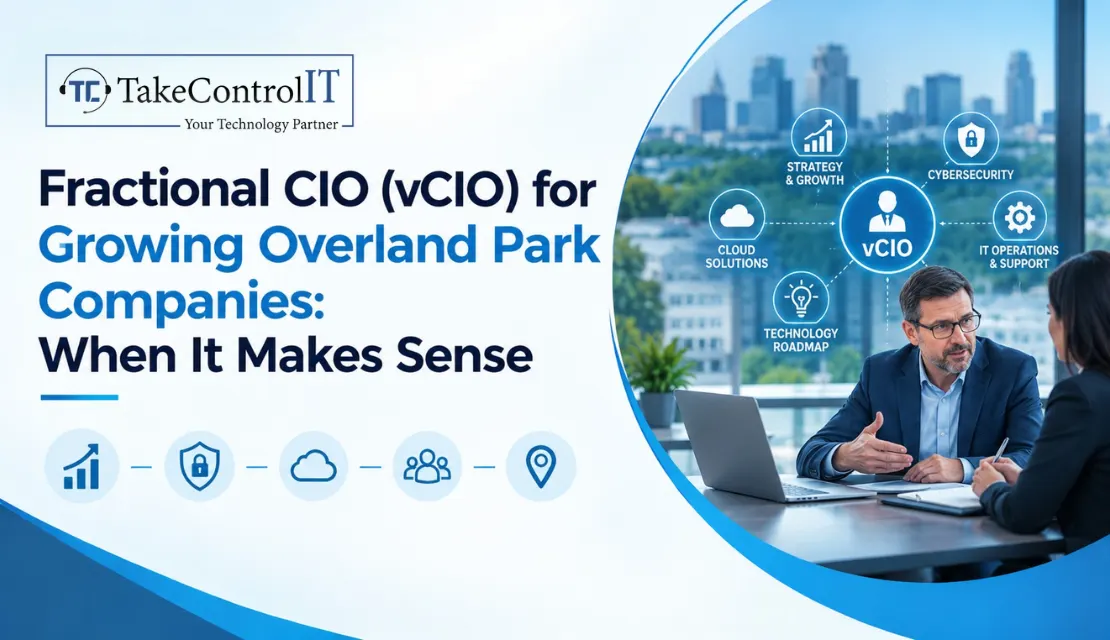
A Fractional CIO is a senior technology leader who works with your company part-time, usually on a monthly retainer. Instead of fixing tickets, they own the big picture: strategy, budgets, vendors and risk.
You’ll hear several names for the same idea: vCIO, outsourced CIO and virtual CIO services. Some managed IT providers bundle this role into their packages, while independent consultants sell it on its own. Either way, it’s different from a help desk, which solves daily problems, and from a full-time CIO, who works exclusively for one company.
The best Fractional CIO services focus on decisions, not tickets:
Good IT strategy consulting Overland Park companies can use goes beyond a one-time report. It becomes a regular rhythm of reviews and decisions.
Wondering when to bring someone in? These are the usual signals:
If two or three of these sound familiar, it’s worth a conversation.
A full-time CIO is a strategic hire with a full executive price tag. An IT manager keeps systems running day to day. A vCIO sits in between, giving you the strategic layer without the full-time cost. One vendor guide puts a full-time CIO at $250,000 to $400,000 or more per year, compared with roughly $7,500 to $25,000 per month for vCIO services. That’s a vendor’s figure, so treat it as a rough benchmark rather than a quote.
The difference between a CIO and a vCIO isn’t the title or the thinking. It’s the time commitment and the cost.
Honest answer: it varies a lot. Go Fractional reports fractional CIOs charging around $200 to $300 an hour, or roughly $4,500 to $20,000 a month. At the other end, one regional provider quotes retainers of about $1,500 to $4,000 a month for businesses with 20 to 100 employees. The gap comes down to scope. Source: gofractionalcmitsolutions
What moves the price:
Solid IT budget planning is one of the quickest ways a vCIO earns their fee, because it replaces guesswork with a forecast.
Growing professional services firms, healthcare practices, financial companies and multi-location businesses across Overland Park, Leawood and the rest of Johnson County often reach this point at the same time. Local knowledge helps, and so does being able to sit in a room together. If you’re comparing virtual CIO services, ask who actually shows up. And when you’re weighing IT strategy consulting Overland Park providers, ask whether they’ll meet with your leadership team in person.
Many companies get a vCIO as part of broader managed IT services Leawood Kansas businesses already use. If you need strategy plus quick help when something breaks, IT support Leawood KS teams can cover both sides. And if you’re simply deciding whether the model fits, a trusted IT company Leawood Kansas can walk you through the options without pressure.
Growth makes IT decisions bigger and riskier. A vCIO gives you an experienced voice in the room before those decisions get expensive, without adding a six-figure salary.
You don’t need to wait for a crisis. If you’re already asking who’s steering your technology, the answer is probably that someone should be.
Looking for a Fractional CIO Overland Park Companies Can Count On?
TakeControl IT offers a free IT strategy and budget review for local companies. We’ll look at where you are, where you’re heading and how to get there without wasting money.
Call us or contact TakeControl IT today to schedule your review.
1. What is a Fractional CIO?
It’s a senior technology leader who works with your company part-time or on retainer, handling strategy, budgets, vendors and risk instead of daily support tickets.
2. When does a business need a virtual CIO?
Usually when growth, rising IT costs, security questions or a big project start outpacing what your current IT person or provider can handle. If you can’t say who owns technology decisions, that’s the signal.
3. What does a vCIO do?
A vCIO builds your technology roadmap, plans your IT budget, manages vendors, sets security priorities and reports to leadership. They guide decisions rather than fix individual issues.
4. How can a Fractional CIO help a growing business?
They line up technology with your growth plans, keep spending under control, reduce security and compliance surprises, and make sure new locations, hires or acquisitions don’t break your systems.
5. What is the difference between a CIO and a vCIO?
A CIO is a full-time executive employee. A vCIO provides the same kind of strategic leadership on a part-time basis, at a lower cost and with more flexibility.
6. How much do Fractional CIO services cost?
Pricing ranges widely, from a few thousand dollars a month for small businesses to well above $10,000 for more complex needs. Scope, hours and company size drive the cost.
7. Why do small businesses need IT strategy?
Without a plan, IT turns into a pile of one-off purchases and emergency fixes. A simple strategy keeps costs predictable, protects data and helps technology support growth instead of slowing it down.
8. When should a company hire a Fractional CIO?
When nobody senior owns technology decisions and the stakes are rising: rapid growth, a big software or cloud contract, new compliance demands or an upcoming acquisition. Earlier is cheaper than waiting for a crisis.
You’re running late, you pull into a spot, and you scan the QR code on the parking meter to pay. The page looks right. The...


 Latest Blogs

What exactly is Fixed-Cost IT Support? Fixed-cost IT support is a type of IT assistance in which companies pay a...
Get Started

Computers and Networks That Are Too Slow Slow computers and networks are one of the most prevalent recurrent IT issues...
Get Started

Signs of an Issue: Slow Performance: Noticeably sluggish computer or network operations may indicate malicious activity taxing your system’s resources...
Get Started